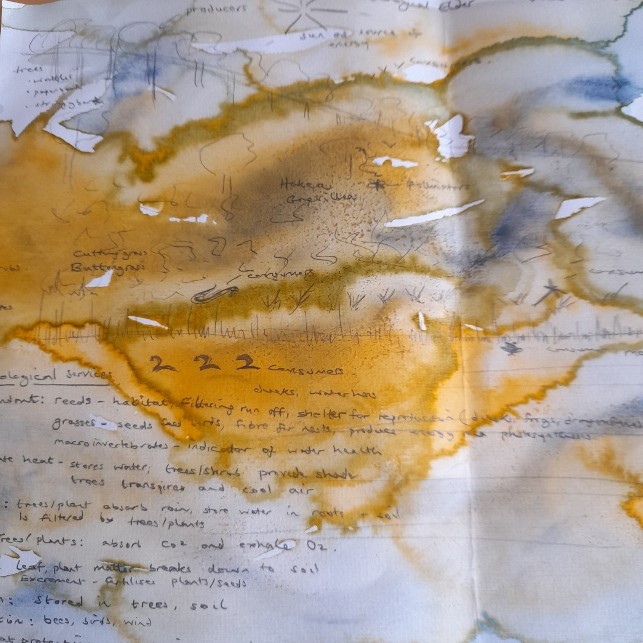
We asked, What ecological services to the community of life does/could our School provide, if we mimic or take inspiration from the swamp elder at Wentworth Falls Lake?
Eco-systems Thinking and specifically, Biomimicry have been the inspiration for a recent Senior School project.
The local hanging swamp at Wentworth Falls Lake was imagined as a biological elder and our initial investigation was into how the swamp functions in providing ecological services to its community of life. We then used this as a model to understand how our School was functioning from an ecological services perspective. This work was informed by Biomimicry – where in this case, we looked for design elements that align with how a local ecosystem functions and solves problems.
With Janine Benyus we asked, What would nature do here? Why?
What wouldn’t nature do here? Why not?
In conducting an audit of energy we appreciated the abundance of the sun and solar energy for a business that operates during daytime hours. Regarding water, we looked at what we were doing and could do better, in storing and filtering water (tanks, tiered plantings, rain garden). We looked at how we could turn our waste into resource (compost, biogas, repurposing), how to protect and extend habitat, and to improve resilience through diversity.
From the audit, we came up with some interesting projects including creating a sustainable outdoor kitchen for high school using biogas and rocket stoves. Can we build it? If we can imagine it, we can.
In reflecting on what was important about inquiring through a biomimicry lens, we agreed that it embodied/embedded our School environment in connection with its adjacent elder, the hanging swamp. School is a process, a series of interconnecting and ever changing relationships, rather than a fixed idea or object. At its core it can respect and serve the community of life of which it is a part right down to its design, build and grow.